You can take an American Heart Association (AHA) PALS class in Millbrae at Safety Training Seminars, an AHA training site on El Camino Real that runs the official PALS Provider course for both initial certification and renewal. You do the coursework online, then come to the Millbrae office for a hands-on skills session. When you pass, you get your AHA PALS Provider eCard the same day. For Peninsula nurses, paramedics, and respiratory therapists who would rather not drive into San Francisco or down to San Jose, it offers a local route to a credential that many pediatric and emergency roles expect.
This article explains how the Millbrae PALS certification course works, how to make sure a card is a real AHA card, what it costs, and how to prepare.
What an “AHA PALS” Credential Should Include
Pediatric Advanced Life Support is the American Heart Association’s advanced resuscitation course for clinicians who treat critically ill infants and children. It assumes you already have strong BLS skills. From there it covers:
- A systematic pediatric assessment approach (evaluate, identify, intervene)
- Recognizing and managing respiratory distress and respiratory failure
- Identifying and treating compensated and hypotensive shock
- Pediatric bradycardia, tachycardia, and cardiac arrest algorithms
- Team roles and closed-loop communication during a resuscitation
A genuine AHA PALS card always comes from a course with an in-person skills component, and it is valid for two years. When a website offers “PALS certification” that is entirely online with no skills check, the card is not an AHA card. Hospitals and agencies that ask for AHA PALS usually turn those down.
How the PALS Course in Millbrae Works
Safety Training Seminars uses the AHA’s self-guided model for PALS in Millbrae. There are two closely related pathways: HeartCode® Complete and the Self-Guided Learning™ option. Both follow the same basic sequence.
Step 1: Finish the Adaptive Online Module
The online portion uses AHA adaptive learning technology. It speeds up on topics you already know and slows down on the ones you miss. The course listing estimates roughly two to three hours. If pediatric rhythms or drug dosing are rusty for you, plan on more time.
Step 2: Book a Skills Session at the Millbrae Office
After the online portion, you schedule a skills session at the Millbrae CPR Verification Station™. The listed skills time is about 30 minutes.
Step 3: Demonstrate Your Skills on Feedback Manikins
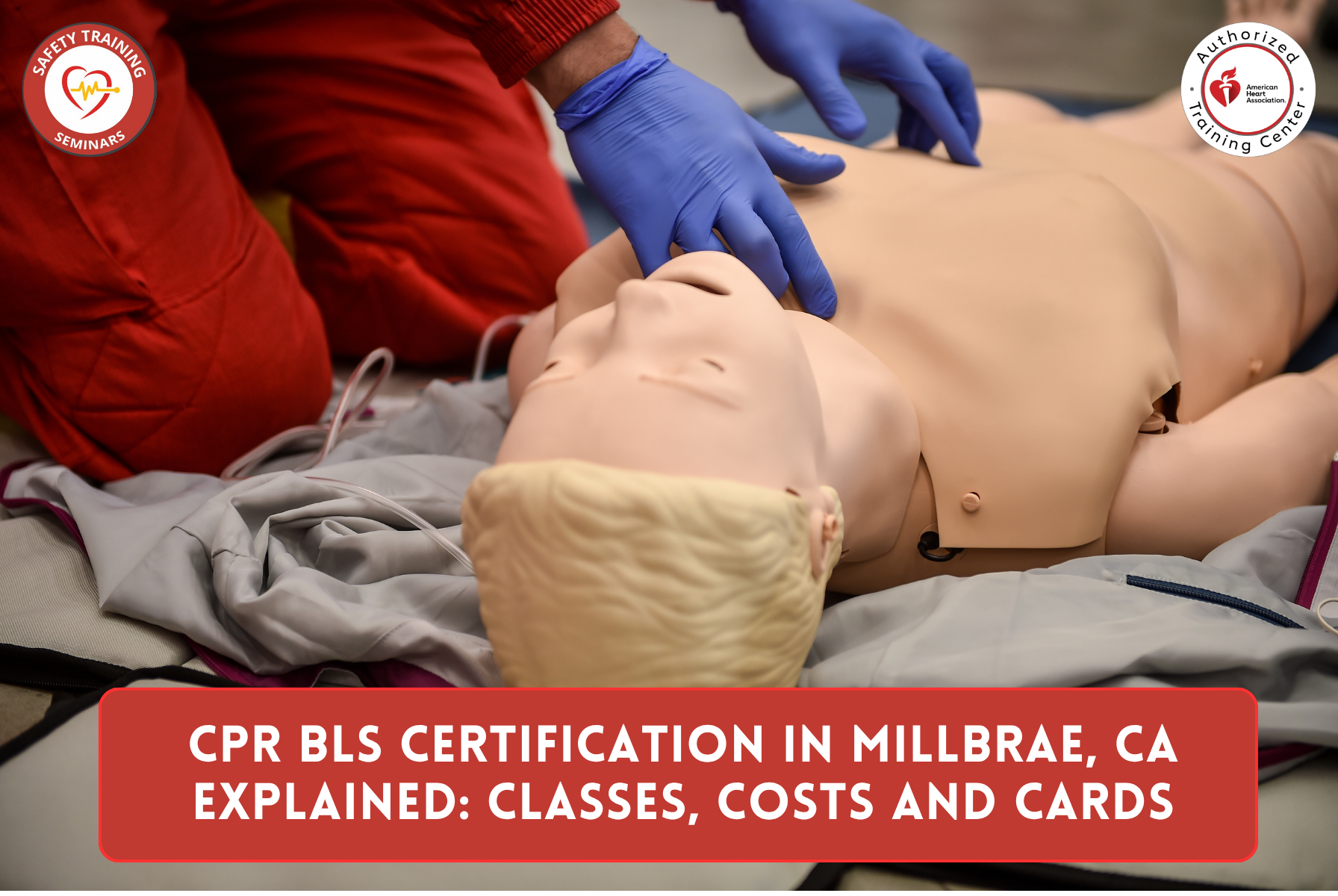
The verification station uses manikins that measure your compression depth, rate, recoil, and ventilation in real time against AHA standards. Many students are surprised to find that this format is self-directed rather than led by an instructor in the room. Video and voice prompts walk you through each skill. If you prefer working at your own pace, that tends to feel like an advantage.
Step 4: Receive Your AHA eCard
Once you meet all requirements, the AHA PALS Provider Course Completion eCard is issued the same day. You can forward it to your manager, nurse educator, or credentialing office right away.
Current format details and booking options are listed on the PALS certification course in Millbrae page.
The Millbrae Training Location
The office is located at Millbrae CPR Training Center Address: 475 El Camino Real, Suite 413, Millbrae, CA 94030, in the El Camino Real and Millbrae Avenue area.
Some practical points for planning your visit:
- Hours: The location lists Monday through Sunday, 8 a.m. to 10 p.m. Evening and weekend slots help if you work twelve-hour shifts.
- Getting there: Highway 101 and El Camino Real both serve the area. Millbrae Station, the BART and Caltrain hub off Millbrae Avenue, is an option if you’d rather not drive. Check your exact route before your appointment.
- Other courses on-site: The same location handles AHA BLS and ACLS, NRP from the American Academy of Pediatrics, and CPR and first aid. If several of your cards expire around the same time, you can complete them in one place.
Who on the Peninsula Typically Needs PALS
PALS is most common among clinicians who might be the first advanced provider at a child’s bedside. In northern San Mateo County, that includes staff at nearby acute care hospitals. Mills-Peninsula Medical Center, a Sutter Health hospital in Burlingame, provides 24-hour emergency care, labor and delivery, and intensive care, and AMA residency data lists both pediatric and neonatal ICU resources there.
Roles that commonly ask for PALS include:
- Emergency department nurses and physicians
- Pediatric, PICU, and NICU nurses
- Labor-and-delivery and postpartum staff (often alongside NRP)
- Paramedics and critical care transport crews
- Respiratory therapists
- Nurse practitioners and physician assistants in urgent care or pediatrics
- Anesthesia and procedural sedation teams
Requirements depend on the employer, the unit, and sometimes the shift. Two nurses at the same hospital can have different credentialing rules. Confirm with your nurse educator or HR before enrolling, especially if you are deciding between PALS alone and PALS plus NRP.
What PALS Costs in Millbrae
At the time of writing, Safety Training Seminars lists AHA PALS certification at $290 and advertises a low-price guarantee with price matching. The Millbrae site has also displayed a promo code offering $25 off AHA BLS, ACLS, and PALS courses.
Pricing and promotions change, so check the current rate before you register. Many Bay Area hospitals reimburse PALS for staff in roles that require it. Ask your employer about reimbursement before you pay, and keep your receipt with your eCard.
Initial Course or Renewal: Which Do You Need?
Choose the initial course if:
- You have never held an AHA PALS card
- Your card expired some time ago and your employer won’t accept a renewal
- You are moving into pediatrics or emergency care from an adult-only specialty
Choose renewal if:
- Your AHA PALS card is current or only recently expired
- You use pediatric assessment and resuscitation skills regularly
When your card has already lapsed, the Millbrae team notes that you may need the full course rather than a renewal. Call ahead to find out which option applies before you start the online module.
Preparing for a Self-Guided PALS Session
A self-guided skills room gives you less on-the-spot coaching than a classroom, so preparation matters more. These steps help:
- Practice infant and child CPR. Compression depth differs by age group, and the feedback manikins pick up shallow or slow compressions immediately.
- Review rhythms before you log in. Practice telling SVT from sinus tachycardia, and bradycardia with poor perfusion from a stable slow rhythm.
- Memorize the decision points in the algorithms. You need to know when to give epinephrine, when to shock, and when to consider synchronized cardioversion.
- Use the AHA precourse materials. Work through the self-assessment and treat any weak areas as your study list.
- Book your skills session soon after the online work. The material stays fresher when the two parts are close together.
Frequently Asked Questions
Is PALS hard to pass?
PALS is more demanding than BLS, but most well-prepared clinicians pass. The adaptive online module returns to topics you miss, so the cognitive portion builds in remediation. The hands-on session goes much more smoothly if you practice pediatric CPR beforehand.
How long does the whole process take?
Plan on about two to three hours for the online module and roughly 30 minutes for the skills session in Millbrae. Initial students and anyone rusty on pediatric content often take longer online.
Will hospitals accept a PALS card from a self-guided course?
Most employers accept HeartCode Complete and other AHA self-guided formats because the result is the same AHA PALS Provider eCard as classroom training. Policies vary, so confirm with your employer if you have any doubt.
Do I need PALS and NRP?
That depends on your role. PALS covers infants and children in emergency and critical care settings, while NRP focuses on newborn resuscitation at delivery. Labor-and-delivery and NICU staff are often asked to hold both.
Can I come from San Bruno, Burlingame, or South San Francisco?
Yes. The Millbrae site draws students from neighboring Peninsula cities, including San Bruno, Burlingame, Hillsborough, and South San Francisco. There is no residency requirement to train there.
Getting Started
The shortest answer to where you can find AHA PALS certification in Millbrae is the Safety Training Seminars office on El Camino Real. You complete the online learning when it suits you, finish the hands-on session nearby, and leave with your AHA PALS eCard the same day. Before booking, confirm your employer’s requirements, decide whether you need the initial course or renewal, and review pediatric rhythms and algorithms ahead of time.
To see the full course lineup, including BLS, ACLS, NRP, and CPR and first aid, visit Safety Training Seminars’ Millbrae training center and pick a skills session that fits your schedule.