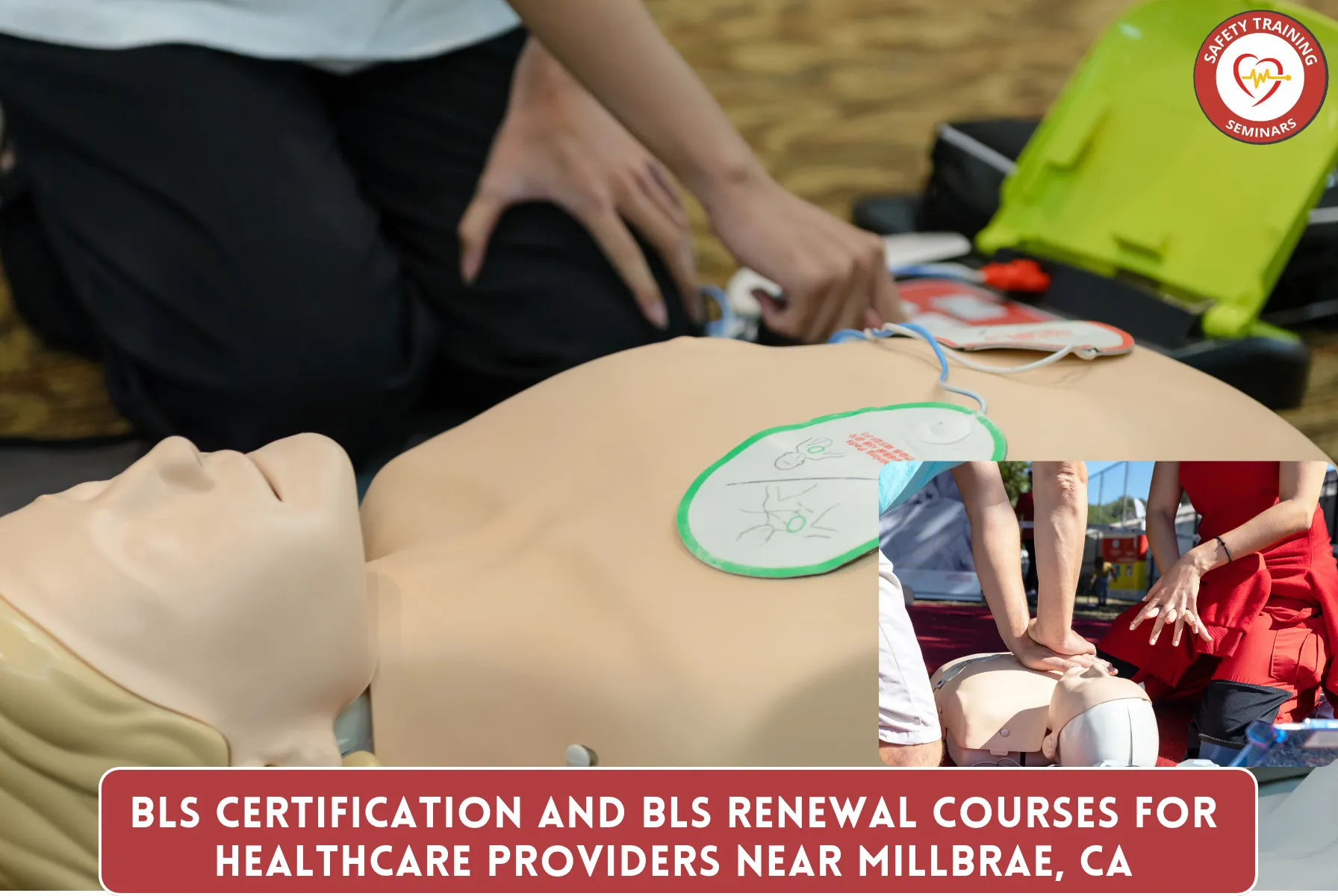
There are many places in and around Millbrae where people work in health care. A respiratory therapist might work in an ICU in nearby Burlingame, a licensed vocational nurse might be on the nite shift at a skilled nursing facility on Mateo Avenue, and an urgent care team might be getting to know travelers at San Francisco International Airport all in the same day. Heart failure can happen in any of these places, even though they look very different. Basic Life Support is what the first few minutes of the reaction depend on. This guide tells you what the training covers, how it can be used in local care settings, and how to choose the right course, whether you need your first course or want to renew your BLS certification near Millbrae.
Basic Life Support, Defined for Clinical Teams
Basic Life Support (BLS) is the set of core resuscitation skills healthcare providers use when a patient stops breathing normally or loses a pulse. These skills include recognizing cardiac arrest quickly, calling for help, giving high-quality chest compressions, delivering effective ventilations, and using an automated external defibrillator (AED) as early as possible.
The American Heart Association (AHA) BLS Provider course teaches these skills in the way clinical teams actually use them. Providers check for a pulse, work in multi-rescuer teams, use bag-mask devices, and coordinate their actions until advanced life support arrives.
Is BLS the Right Course for Your Role?
BLS is a healthcare-provider course. General-public CPR programs, such as the AHA’s Heartsaver courses, are designed for laypeople and non-clinical workers and do not include the same professional-level, team-based skills.
A patient-facing clinician usually needs BLS. A receptionist, office manager, or fitness instructor may be fully served by a general CPR course. The correct choice depends on your role, your employer’s policy, and any school or licensing-related requirements. Confirm those before you register.
One Skill Set, Many Settings: BLS Around Millbrae
Acute Care and Emergency Departments
Millbrae’s closest acute-care hospital is Sutter Health’s Mills-Peninsula Medical Center, located in neighboring Burlingame at 1501 Trousdale Drive. The hospital provides emergency, cardiovascular, intensive care, respiratory, and labor and delivery services, and its emergency department is open 24 hours and handles more than 51,000 visits a year. Mills-Peninsula has also been identified as the official destination for medical emergencies at San Francisco International Airport.
In a high-volume emergency department or inpatient unit, BLS is the base that advanced resuscitation is built on. Whatever advanced interventions follow, the patient’s chances depend heavily on how well and how early compressions, ventilation, and defibrillation are delivered.
Skilled Nursing and Long-Term Care
Millbrae Care Center, a skilled nursing facility at 33 Mateo Avenue, is one example of the long-term care settings in the community. Staff in these facilities often care for older adults with heart disease and other chronic conditions, and they may be the only responders until emergency medical services arrive.
For nurses and nursing assistants in this setting, BLS training supports quick recognition of a deteriorating resident and organized action in the minutes before paramedics take over. These responses should always follow facility policy, including each resident’s documented care preferences.
Urgent Care, Outpatient, and Dental Offices
Not every cardiac emergency happens in a hospital. Urgent care clinics, including the SFO Medical Clinic in the airport’s International Terminal, outpatient practices, and dental offices all see patients who may become critically ill without warning.
In these settings, emergencies are uncommon, so BLS skills can fade between uses. Regular renewal and practice help medical assistants, dental hygienists, dental assistants, and clinic nurses remember where the AED is, who calls 911, and how to start compressions without hesitating.
What Happens During a Resuscitation Attempt
The Skills Every Provider Practices
An AHA BLS course gives learners hands-on practice with the skills that most affect survival:
- Recognizing cardiac arrest by checking responsiveness, breathing, and pulse
- High-quality CPR for adults, children, and infants, with the correct rate, depth, and full chest recoil
- Keeping interruptions in compressions as short as possible
- Using an AED promptly and safely
- Giving ventilations with a barrier device and a bag-mask device, without over-ventilating
- Relieving choking in responsive and unresponsive patients
Team Roles and Closed-Loop Communication
BLS turns into a team sport when more than one service responds at the same time. Compressor, airway and ventilation manager, AED operator, team leader, and sometimes a recorder are some of the jobs that people usually play. Compressors are usually switched every two minutes, or sooner if rescues get tired, because as they get tired, the quality of the compression drops.
Teams work best when they can talk to each other clearly. When communication is closed-loop, the team leader tells a member of the group what to do, the member repeats it, and then everyone agrees that it was done. This keeps you from missing tasks and doing the same work twice during a stressful code. In a BLS course, practicing these patterns helps providers work well with coworkers they might not know very well, which is usual for float pool, travel, and per diem staff.
First Course or Renewal? Matching the Course to Your Situation
An initial BLS Provider course is usually the right starting point for healthcare students, new graduates, people moving into clinical roles, and anyone whose prior BLS card has lapsed. It gives more time to build technique and confidence before skills testing.
A renewal course is designed for providers who already hold a current AHA BLS Provider card. It reviews the same science and skills at a faster pace, with an emphasis on practice and updates. Both paths lead to the same AHA BLS Provider Course Completion Card, which the AHA lists as valid for two years.
Before booking a renewal, work through these steps:
- Check the date on your current eCard. Note when your current card’s two-year period ends.
- Review your employer’s or school’s policy. Some organizations set their own timelines or require a particular course format.
- Confirm renewal eligibility with the training center. The AHA directs learners to their training center for renewal details, and eligibility rules can differ. If your card has expired, you may need the initial course.
- Choose a format that fits your schedule. Pick the delivery method your employer accepts and that suits how you learn best.
- Refresh before your skills session. Reviewing compression technique, infant skills, and AED steps beforehand makes testing smoother.
AHA Learning Formats for BLS
The AHA offers BLS through several delivery methods, all teaching the same skills and leading to the same completion card:
- Classroom BLS: the entire course, including skills practice and testing, is completed with an AHA Instructor.
- HeartCode® BLS: a blended learning option in which the online portion is completed independently, followed by a hands-on skills session.
- Self-Guided Learning™: the cognitive portion is completed online, and the hands-on portion is completed at an approved CPR Verification Station™.
Format availability varies by location, and some employers specify which formats they accept.
Peninsula Healthcare Students: Plan BLS Into Your Clinical Timeline
Many people who want to work in healthcare are trained in northern San Mateo County. The Nursing Program at the College of San Mateo combines learning in the classroom and skills labs with real-life experience at local hospitals and community health centers. The college works with most of the hospitals in San Mateo County. Its materials for students who want to become EMTs point them to AHA BLS training.
There are allied health programs at Skyline College in San Bruno. These include respiratory care (at both the associate and bachelor’s level), surgical technology, anesthesia technology, sterile processing, and emergency medical technology.
In these kinds of programs, students often need proof that they have completed BLS before they can start clinical rotations. In some programs, the card must also be valid until the end of the term. Read up on the requirements for your school early on so that a lost or expired card doesn’t hold up your placement.
Remember what the card stands for as well. An AHA Course Completion eCard proves that you finished a certain AHA course. It’s not a professional license, and it doesn’t take the place of any other licenses or registrations your job needs.
Safety Training Seminars’ Millbrae Training Center
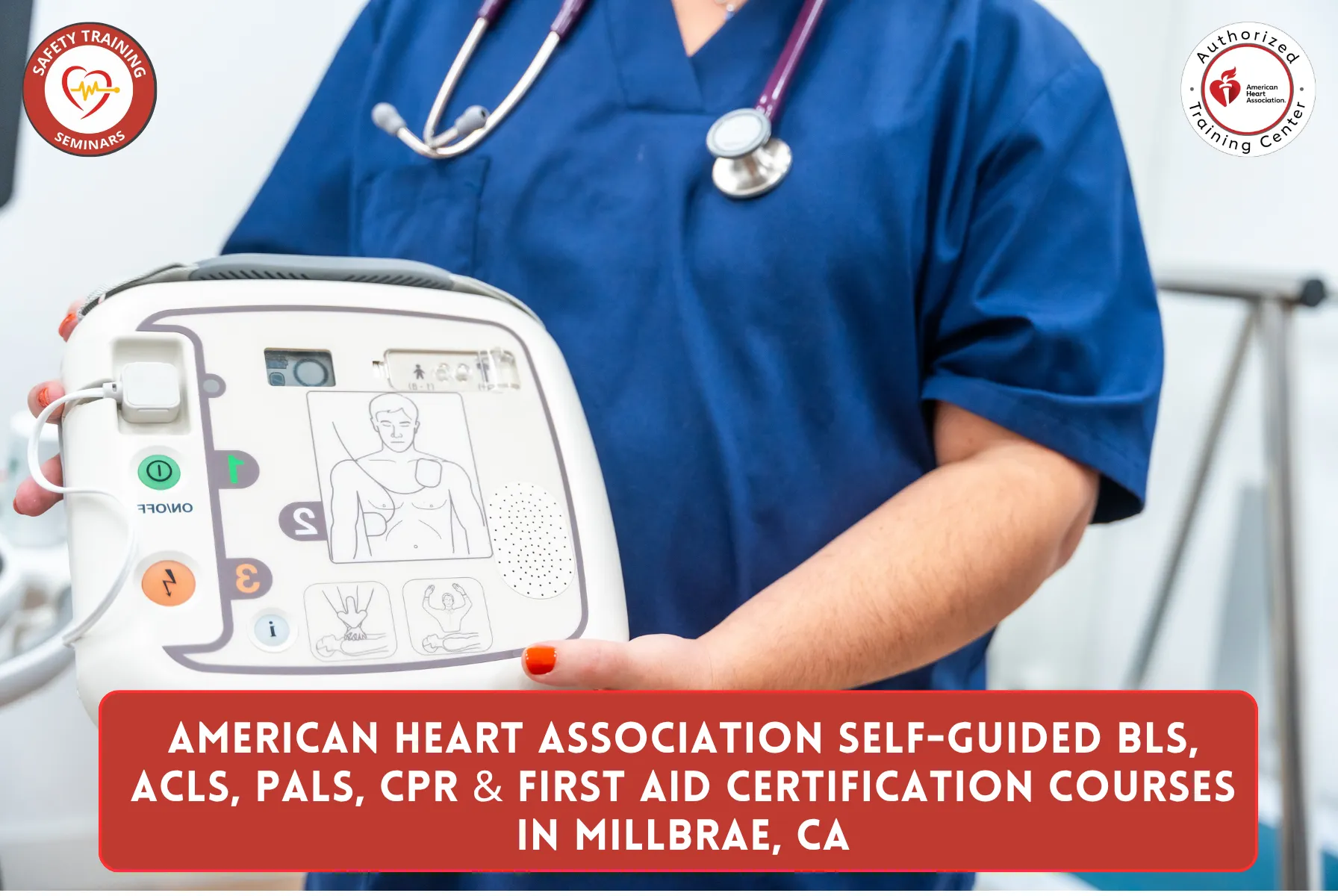
Safety Training Seminars, an AHA Training Center that has offered American Heart Association courses since 1989, operates a training center at 475 El Camino Real, Suite 413, Millbrae, CA 94030. The BLS Provider course is offered for both initial and renewal learners, using a format that pairs an online learning portion with an in-person skills session at the Millbrae location.
Healthcare professionals can compare current course options and register through the BLS training in Millbrae course page. Learners who complete an applicable AHA course receive an AHA Course Completion eCard. Check the course page for current schedules and details, and confirm with your employer or school that the course meets their requirements.
Common Questions From Millbrae-Area Providers
Is there a BLS training center in Millbrae itself?
Yes. Safety Training Seminars’ Millbrae training center is located at 475 El Camino Real, Suite 413, Millbrae, CA 94030.
Do respiratory therapists, surgical technologists, and dental staff take the same BLS course as nurses?
The AHA BLS Provider course is designed for healthcare professionals across disciplines, so many roles take the same course. Your employer or program may specify a particular course or format, so confirm before registering.
How far ahead should I plan my BLS renewal?
There is no single rule for every provider. The AHA BLS Provider card is valid for two years, but employers and schools may set their own deadlines. Check your current card date and your organization’s policy, then book with enough time to avoid a gap.
Does the blended format still include hands-on skills testing?
Yes. In HeartCode® BLS and Self-Guided Learning™, the online portion covers the cognitive material, and learners still complete a hands-on skills portion before receiving a completion card.
Will my employer automatically accept my BLS course?
Not necessarily. Requirements vary by organization. Ask your employer, school, or clinical site which course and format they require before you enroll.
Stay Ready for the Next Code
Across all of these settings, whether a busy emergency department, a skilled nursing facility, an airport clinic, or a dental office, resuscitation starts with the same skills: early recognition, high-quality CPR, early defibrillation, and teamwork. If your card is approaching its renewal date, or you are preparing for your first clinical rotation, explore AHA BLS courses near Millbrae with Safety Training Seminars and choose the option that fits your requirements.